
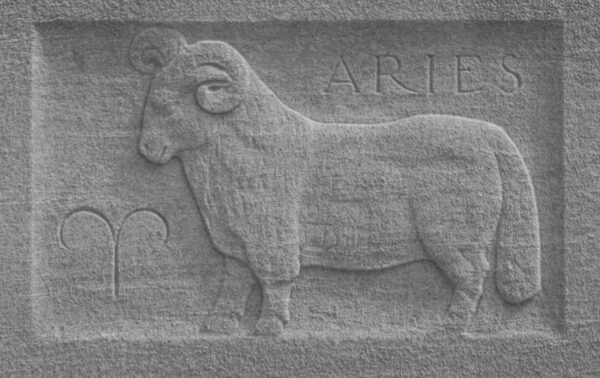
In astrological tradition, Aries is associated with Mars, the impulse of beginning and direct action. In philosophical readings, the sign often functions as a metaphor for polemics: sharp theses, quick responses, and a desire to bring the debate to a clear conclusion. This temperament is especially noticeable in public intellectual culture, where debate becomes a form of thinking and a way of setting the framework for discussion.
Famous Aries and their characters
This set of figures represents different disciplines: evolutionary biology, philosophy of consciousness, political journalism, moral philosophy, and political theory. They have one thing in common: each of these authors was born under the sign of Aries and developed a recognizable style where force and clarity work together.
Richard Dawkins, March 26, 1941, Aries
Dawkins made popular biology a zone of ideological dispute and placed evolutionary explanation at the center of the conversation about man and culture. The Selfish Gene and The Blind Watchmaker established a language in which a rigorous model competes with religious and metaphysical interpretations on equal terms, without concessions in terms of terminology.
Dawkins’s manner is based on precise wording and public attacks on vague definitions. The thesis is stated briefly, followed by a series of clarifications, after which the opponent is subjected to a harsh analysis of logical holes. This style often resembles an intellectual duel, where an argument works like a blow, and irony increases the pressure.
The Aries temperament here reads as the energy of conflicting ideas. Dawkins chooses an offensive position, keeps up a fast pace, and rarely leaves a dispute unresolved. The result is a clear boundary between explanation and belief.
Daniel Dennett, March 28, 1942, Aries

Dennett shaped the language of modern philosophy of mind and cognitive science through his analysis of intentionality, his critique of the “Cartesian theater,” and his explanation of consciousness as the result of distributed processes.
Dennett’s style is methodical. First comes the clarification of concepts, then the dismantling of intuitions, then the assembly of a more economical model that explains more with fewer assumptions.
- Dennett uses thought experiments to test explanations.
- Dennett links philosophical questions to data from psychology and neuroscience.
- Dennett promotes the language of mechanisms over the language of mystery.
The polemical nerve remains, but it works calmly. Aries manifests itself in the stubborn discipline of argument: Dennett argues until only the structure of the explanation and verifiable consequences remain.
Christopher Hitchens, April 13, 1949, Aries
Hitchens turned politics, religion, and moral criticism into a genre of theatrical debate, where rhetoric serves as a tool of analysis. God Is Not Great and Hitch-22 showcase a style that combines erudition, pamphleteering, and a penchant for head-on collisions.
Hitchens’ speech is highly charged. His arguments are rarely gentle, often sounding like a challenge. In such debates, his opponents are questioned about their honesty, courage, and responsibility for their words.
Hitchens’ Aries manifests itself as a willingness to argue publicly and to the end. This approach has a clarifying effect, because the debate removes the mask of general formulations and forces people to explain the basis of their position. At the same time, Hitchens’ style retains its literary quality and taste for quotations, so the pressure does not turn his speech into a dry outline.
Sam Harris, April 9, 1967, Aries
Harris constructs a conversation about morality, violence, religious radicalism, and consciousness through rational language. The End of Faith and The Moral Landscape set the tone for ethics to be recognized as a subject of analysis.
Harris’s tone is maintained by demonstrating extreme cases. First, a clearly defined thesis appears, then an example that reveals the stakes, then a conclusion that sets the framework for the discussion.
- Harris links moral conclusions to facts about suffering and well-being
- Harris brings the topic of violence to the center of the conversation about values
- Harris uses clear definitions as a way to keep the debate rational
Aries is evident in the desire to control the conversation’s trajectory. Harris rarely leaves room for ambiguity and often chooses a rigid structure in which the argument follows a predetermined logic.
Thomas Hobbes, April 5, 1588, Aries

Hobbes laid the foundation for one of the main lines of modern political philosophy. Leviathan constructs a model of society where fear and violence set the initial conditions, and power solves the problem of ending the “war of all against all.”
Hobbes adopts harsh premises and, on their basis, constructs a system that explains why society needs strong order. This move sets a cold clarity: ideals fade into the background, and the question of manageability and preventing disintegration comes to the fore.
Aries manifests itself as intellectual straightforwardness. Hobbes does not embellish the picture of human nature and does not hide his conclusions behind diplomatic wording. The argument is a construct based on the fear of death and the desire for self-preservation. This harshness makes Hobbes a constant point of contention in political theory, because the text asks uncomfortable questions about the price of security.
Conclusion
Aries in philosophical metaphor often appears as a sign of authors who choose clear boundaries and active debate. Dawkins, Dennett, Hitchens, Harris, and Hobbes, each in their own field, show one motif: the thesis requires a strike at the weak point, and the dispute requires bringing it to the structure. This style helps to purify language and clarify the basis of positions. At the same time, such a temperament requires discipline so that the pressure serves the thought.